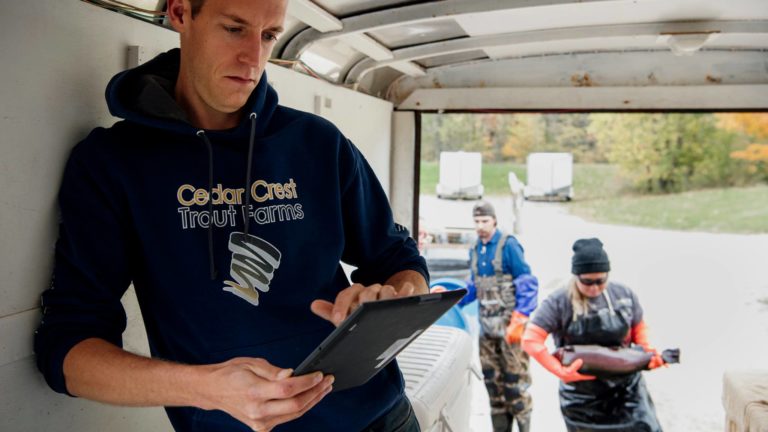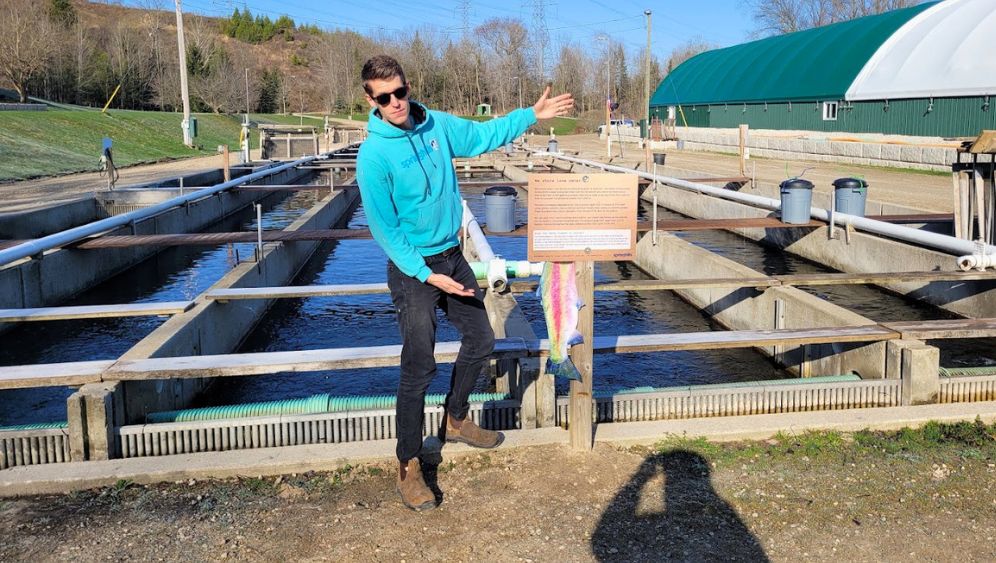
The short version: Yes, you can come to Springhills Fish and take a self-guided walk around our working fish farm near Hanover, Ontario.
We opened the farm because fish farming is still misunderstood, and we think one of the best ways to explain what we do is simply to let people see it for themselves.
We put up signs, set a few boundaries, and opened the gates.
So far, it has worked pretty well.
You let people just walk around the fish farm?
Whenever we tell other farmers that the public can come walk around parts of our farm on a self-guided tour, we usually get a LOT of questions.
- What if there are dead fish?
- What if someone falls in the water?
- What about all the equipment running?
- What about activists?
- Won’t visitors get in the staff’s way?
We worried about all of those things too.
Then we opened the gates, put up signs, and welcomed people in.
And honestly? Nothing particularly fishy has happened!
Why open a working fish farm to the public?
Our dad has always said the second job of every fish farmer is education.
The first job is, of course, keeping the fish alive.
Fish farming is still pretty misunderstood. We’re also relatively new kids on the farming block compared with other types of agriculture.
Most people have driven past fields of cattle or crops.
Far fewer people have stood beside a tank full of trout and seen how a fish farm actually works.
We’ve found one of the best ways to clear up misconceptions is simply to let people see it for themselves.
People were already coming anyway
Opening the farm was also partly out of necessity.
Years ago, people would find us online and drive all the way out to the farm just to make sure we were real.
They would pull into the driveway, roll down the window, confirm that there were indeed fish and fish farmers here, and then drive away.
Apparently buying fish from strangers on the internet required a little verification.
So eventually we figured:
Come on in.
What can you see on the farm tour?
Visitors can walk around our outdoor tanks and see trout at different stages of their life cycle, from small fingerlings right up to our largest breeding fish.
Along the way, we have signs explaining what you’re looking at, how the farm works, and plenty of facts about raising fish.
You’ll learn about things like:
- How we raise our fish
- What our fish eat
- Where the fish go
- How we care for them
- How the farm works
- How we protect fish health
- And yes, there are a few fish puns along the way too.
The whole tour usually takes about 15 to 30 minutes.
There is no need to book a formal tour or have a staff member walk around with you. The idea is that you can explore at your own pace.
Are there parts of the farm visitors can’t enter?
Absolutely.
This is still a working farm.
Our early-rearing building, for example, stays biosecure because very young fish are sensitive and we don’t want visitors accidentally bringing bugs or disease into those areas.
There are also working areas and equipment that remain for staff only.
Opening the farm doesn’t mean opening every door.
It means giving people a safe way to see the parts of the farm that make sense to share.
What if you see a dead fish?
You might.
Fish are livestock, and some fish perish. That’s a normal part of raising animals.
We actually have a sign explaining fish mortality.
We added it after visitors would occasionally seek out one of our staff members specifically to tell us they had spotted a dead fish.
We appreciate that people care.
But we’d rather explain mortality openly than pretend it doesn’t happen.
Fish farming involves healthy fish, sick fish, growth and sometimes losses, just like other livestock farming.
Does having visitors interfere with the farm?
Not really.
That’s one of the reasons the tour is self-guided.
Our staff still have fish to feed, equipment to maintain, water systems to monitor, and plenty of other work to do.
Visitors can learn about the farm without needing someone to stop working and lead a formal tour every time a car comes down the driveway.
It gives people access while still allowing the farm to operate like a farm.
Why transparency matters in fish farming
People have lots of questions about aquaculture.
- What do farmed fish eat?
- How are they cared for?
- What happens to the water?
- What about fish health?
- What does a fish farm actually look like?
Those are fair questions.
We can answer them on our website, in videos, and on social media.
But there is something different about standing beside a tank full of trout and seeing it yourself.
You can see the fish.
You can see the water.
You can see the equipment.
You can see that this is simply a farm, except our livestock happens to swim.
Sometimes seeing it makes fish farming a lot less mysterious.
Why we keep the gates open
We originally opened the farm because we wanted people to better understand where their food comes from.
We’ve kept doing it because people are genuinely curious.
They want to see the fish. They want to understand how they’re raised. And they want to know more about where their food comes from.
We’d much rather show people than simply tell them.
Sometimes the easiest way to tackle a misconception about fish farming is to let people come see it for themselves.
Frequently Asked Questions
Can I visit Springhills Fish?
Yes. Springhills Fish offers a self-guided tour of the outdoor areas of our working fish farm near Hanover, Ontario. Visitors can walk around the outdoor tanks and see trout at different stages of their life cycle.
Do I need to book a fish farm tour?
No. The farm tour is self-guided, so you can visit during our open hours and explore the designated tour area at your own pace.
When is the Springhills fish farm open for tours?
The farm is open 7 days a week from 7am to 9pm, including holidays.
How long does the farm tour take?
Most people take about 15 to 30 minutes to complete the self-guided tour.
What will I see on the tour?
You’ll see our outdoor fish tanks and trout at different stages of their life cycle, from fingerlings to our largest breeders. Signs along the route explain what you’re seeing and how the farm works.
Is the whole fish farm open to visitors?
No. Some areas remain closed for fish health, biosecurity, safety, and normal farm operations.
Is the farm tour accessible?
The tour covers approximately 1,000 feet of level, unpaved gravel ground.
What should I wear?
Please wear shoes suitable for walking around a working farm. The tour is outdoors and on unpaved gravel.
Are there public washrooms?
No. There are no public washrooms at the farm. Public washrooms are available nearby at the Allan Park Conservation Area.
Can I bring my dog?
Please leave visiting dogs inside your vehicle and ideally out of view. Our farm dogs are friendly with people but can be suspicious of other dogs because they’re trained to help protect the property.
Can I buy fish while I’m there?
Yes. After the tour, you can visit our self-serve fish store on the farm, which carries a selection of Canadian fish. There’s no need to reserve your fish in advance.
Where is Springhills Fish?
The farm is located at 133241 Allan Park Road, Hanover, Ontario.
Learn more on our Visit page.
Related
Items
Why Most Fish Travels Farther Than You Think
Is Trout Salmon? A Guide to Rainbow Trout, Steelhead and Different Types of Salmon